

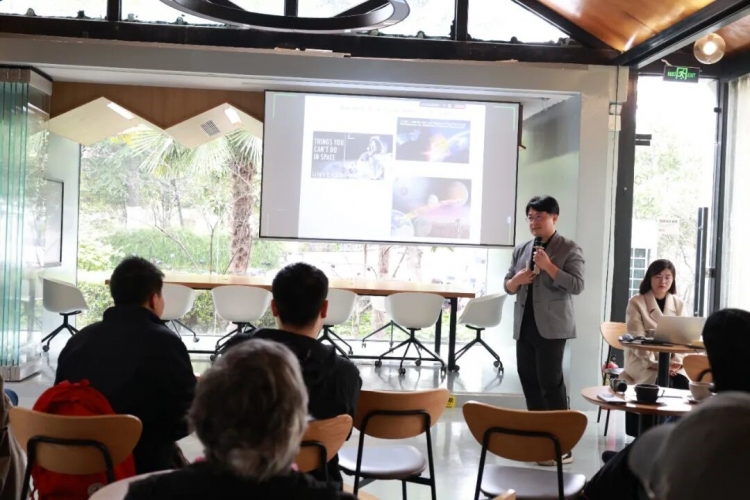
On the afternoon of October 31, 2025, the 39th Deep Space Exploration Academic Salon was successfully held at the USTC 1958 Café on the East Campus of the University of Science and Technology of China. This salon focused on the frontier research of terrestrial planetary internal structures. It specially invited Professor Duckyoung Kim and Researcher Longjian Xie from the Center for High Pressure Science and Technology Advanced Research (HPSTAR) in Beijing as keynote speakers to share their latest scientific achievements. The event attracted extensive participation from researchers, faculty, students, and science enthusiasts both from USTC and other institutions.
Professor Kim delivered a presentation titled "Superionic Phenomena in the Interiors of Terrestrial Planets", systematically introducing his research progress on the physical states of matter inside terrestrial planets under extreme temperature and pressure conditions. Focusing on the critical role of iron in planetary core evolution, he combined theoretical simulations with experimental data to deeply explain the formation mechanisms of superionic iron-based compounds in the deep lower mantle and inner core. He pointed out that the interaction between iron and elements such as hydrogen and water can induce a superionic transition, and further proposed that pressure-induced electronegativity transition may be the core driving mechanism behind this phenomenon. This research provides a new theoretical basis for understanding the material behavior and evolutionary paths within planetary interiors.
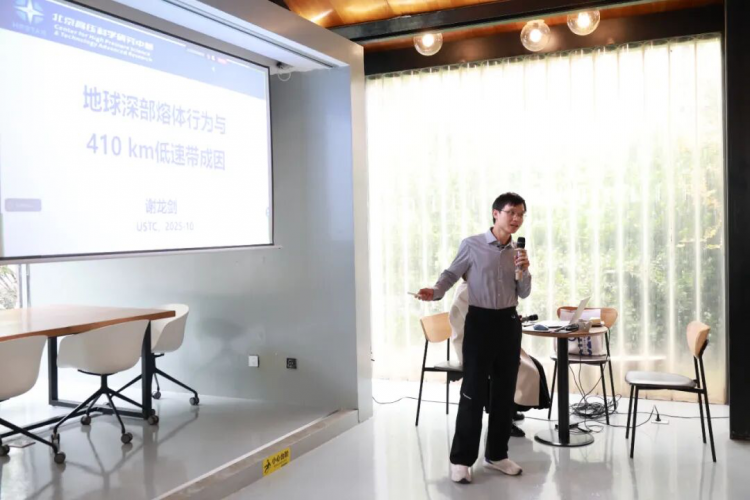
Researcher Xie's presentation, titled "Deep Earth Melt Behavior and the Origin of the 410 km Low-Velocity Zone", explored the structural genesis of the low-velocity zone located at a depth of 410 kilometers inside the Earth. He systematically analyzed the complex characteristics of this region on a global scale, which are "extensive but discontinuous, with coexisting single- and double-layer structures." By comprehensively utilizing melt composition measurements, viscosity analysis, and finite element simulations, he concluded that the presence of water-rich and iron-rich melts is the key factor causing the lateral discontinuity of the low-velocity zone. Furthermore, the coupling effect between low-viscosity melts and the continuous dehydration melting process reasonably explains the coexistence of its single- and double-layer structures. This achievement provides a new perspective for understanding deep Earth structures and dynamic processes.
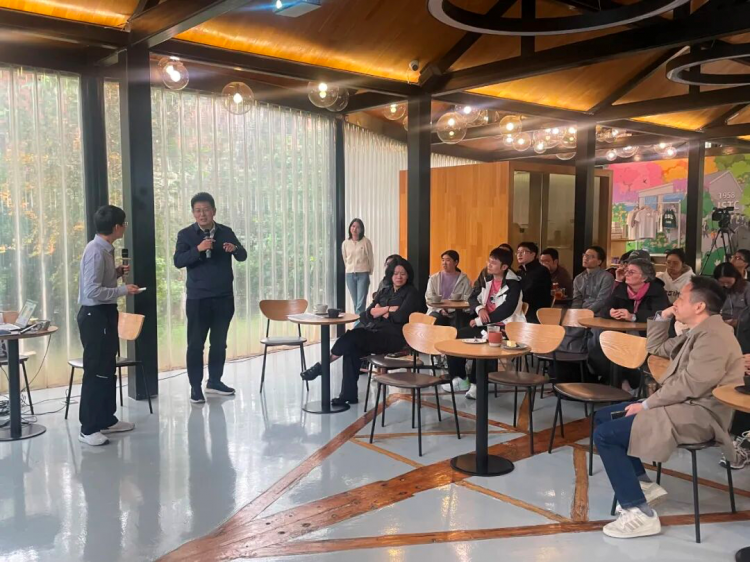
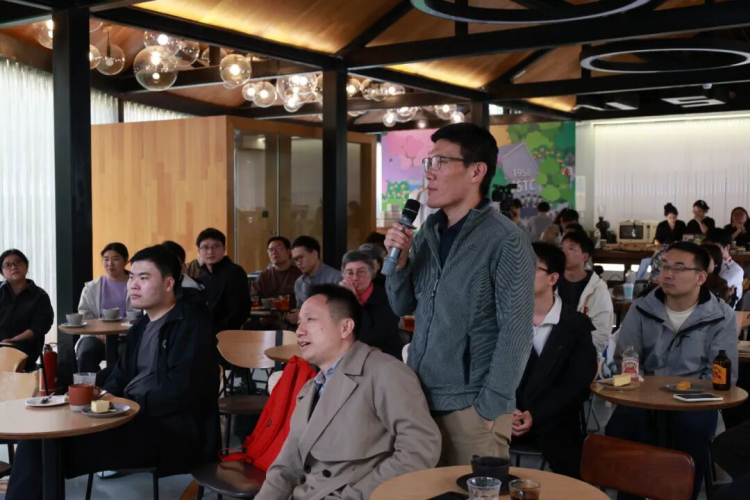
The salon was held in a hybrid format combining offline exchange with live streaming. The atmosphere at the venue was lively, and during the interactive Q&A session, participating teachers and students actively asked questions regarding research methods, data interpretation, and scientific inferences. The two speakers provided detailed answers one by one, leading to in-depth and inspiring discussions. Online, the event was broadcast simultaneously via Tencent Meeting and the Koushare Academic platform. As of press time, the cumulative number of views has exceeded 3,000, effectively expanding the coverage and influence of academic sharing.
The study of terrestrial planetary internal structures is an important direction for revealing the formation and evolution mechanisms of the solar system, and it is also one of the key scientific issues driving the development of deep space exploration. This salon has built an open and cutting-edge communication platform for scholars in the field, effectively promoting the collision of ideas and mutual learning of methods between different research directions. In the future, the Deep Space Exploration Academic Salon will continue to invite experts and scholars from home and abroad to share innovative achievements, stimulate scientific cooperation, and inject new impetus into the sustainable development of China's deep space exploration cause. We look forward to reuniting with colleagues at future academic events to jointly explore the unknown mysteries of the universe!
第39期深空探测学术沙龙成功举办 聚焦类地行星内部结构前沿研究
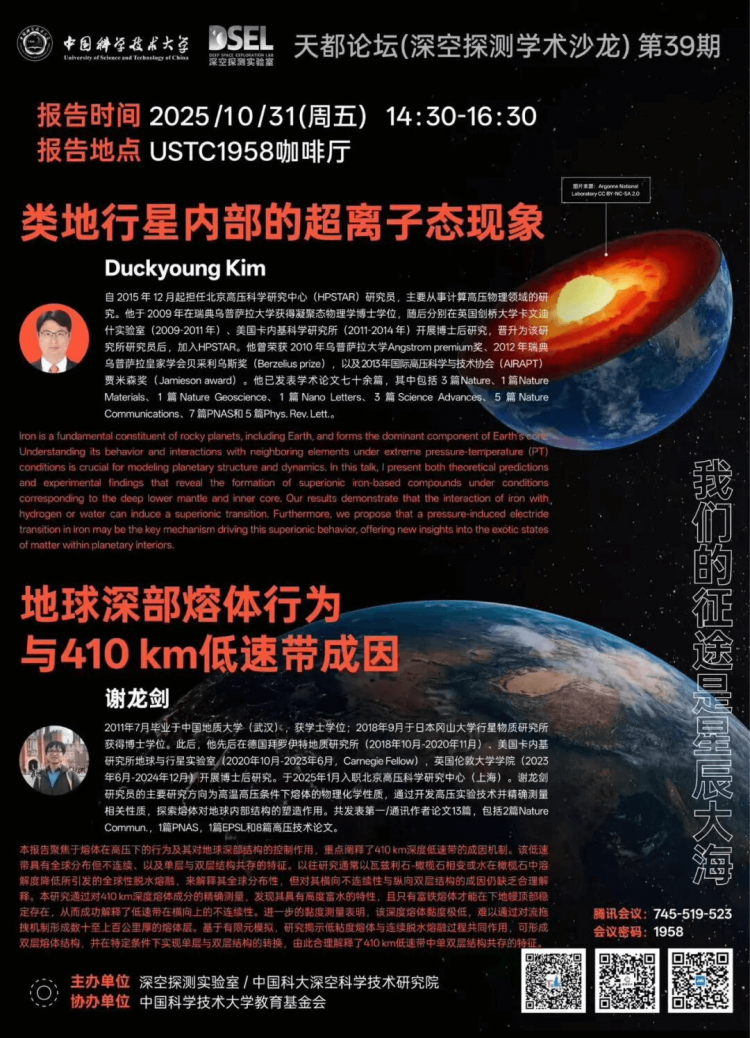
2025年10月31日下午,第39期天都论坛(深空探测学术沙龙)在中国科学技术大学USTC1958咖啡厅成功举行。本期沙龙聚焦类地行星内部结构的前沿研究,特邀北京高压科学研究中心的Duckyoung Kim研究员与谢龙剑研究员担任主讲嘉宾,分享最新科研成果,吸引了来自校内外的科研人员、师生及科研爱好者广泛参与。
Duckyoung Kim研究员以“类地行星内部的超离子态现象”为题,系统介绍了其在极端温压条件下类地行星内部物质状态方面的研究进展。他围绕铁元素在行星核心演化中的关键作用,结合理论模拟与实验数据,深入阐释了深下地幔与内核中超离子态铁基化合物的形成机制,指出铁与氢、水等元素的相互作用可诱导超离子转变,并进一步提出压力诱导的电负性转变可能是其背后的核心驱动机理。该研究为理解行星内部物质行为与演化路径提供了新的理论依据。
谢龙剑研究员则以“地球深部熔体行为与410 km低速带成因”为题,探讨了地球内部410 公里深度低速带的结构成因。他系统分析了该区域在全球尺度上“分布广泛但不连续、单双层结构并存”的复杂特征,综合运用熔体成分测量、粘度分析与有限元模拟等手段,指出富水富铁熔体的存在是导致低速带横向不连续的关键因素,而低粘度熔体与持续脱水熔融过程的耦合作用,则合理解释了其单—双层结构共存的现象。该成果为认识地球深部结构与动力学过程提供了新的视角。
本次沙龙采取线下交流与线上直播相结合的方式举办,现场气氛热烈,互动环节中与会师生围绕研究方法、数据解读与科学推论等方面踊跃提问,两位主讲人一一作出细致解答,交流深入,启发性强。线上通过腾讯会议与蔻享学术平台同步直播,截至发稿前累计观看量已超过3000人次,有效拓展了学术分享的覆盖范围与影响力。
类地行星内部结构研究是揭示太阳系形成与演化机制的重要方向,也是推动深空探测事业发展的关键科学问题之一。本次沙龙为领域内学者构建了一个开放、前沿的交流平台,有效促进了不同研究方向之间的思想碰撞与方法互鉴。未来,深空探测学术沙龙将继续邀请海内外专家学者分享创新成果,激发科研合作,为我国深空探测事业的持续发展注入新动力。我们期待在未来的学术活动中与各位同行再聚,共同探索宇宙未知奥秘!

Institute of Deep Space Science and Technology