

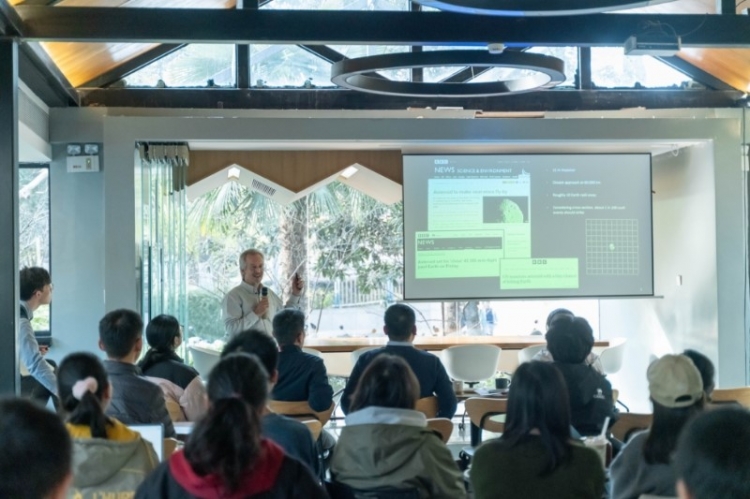
On the afternoon of November 13, 2025, the 41st Deep Space Exploration Academic Salon was successfully held at the 1958 Café in the East Campus of the University of Science and Technology of China (USTC). Centering on the core theme of "Planetary Impacts and Solar System Evolution", the salon adopted a dual-channel format of online and offline participation, attracting numerous researchers and students. The on-site Q&A session witnessed intense collisions of scientific ideas, creating an especially strong academic atmosphere.
This salon invited Dr. Gregory Michael from the Institute of Geochemistry, Chinese Academy of Sciences, and Postdoctoral Fellow Liu Tiantian from the Natural History Museum of Germany to deliver two cutting-edge reports. Both taking "planetary impacts" as the core research entry point, their presentations focused on the key goal of deciphering the laws of early solar system evolution and conducted scientific analyses based on deep space exploration-related data.
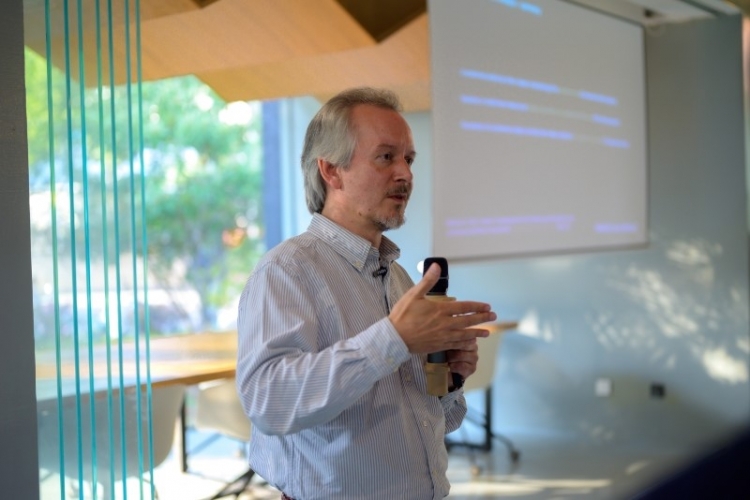
Dr. Gregory Michael delivered a report titled "Crater Size-Frequency Distribution Dating of Planetary Surfaces: Overview and Latest Progress", systematically explaining crater counting—a key technology for interpreting the evolution of planetary surfaces. As one of the core researchers in this field, he first introduced the technical principle: by statistically analyzing the number and distribution of craters of different sizes on planetary surfaces, combined with the temporal probability model of impact events, the formation age of geomorphic units can be inferred. Currently, the CraterStats software developed with Gregory Michael's participation has become a commonly used tool in the international planetary science community, supporting chronological analysis for multiple deep space exploration projects.
Addressing current technical bottlenecks, Dr. Gregory Michael focused on sharing the latest progress: with the explosive growth of planetary exploration data, the research focus is shifting from "ancient planetary-scale landforms" to "smaller and younger geological units". Facing new challenges in crater chronology, he introduced in the report how to reasonably estimate crater dating results and their errors by integrating statistical methods, assess the minimum area of dating regions and the number of craters required, and conduct homogeneity analysis of spatial distribution for secondary craters and surface modifications. These new technical means and research methods have effectively improved the dating accuracy of young geomorphic units and demonstrated the application prospects of this technology in the study of celestial bodies such as Mars and the Moon.

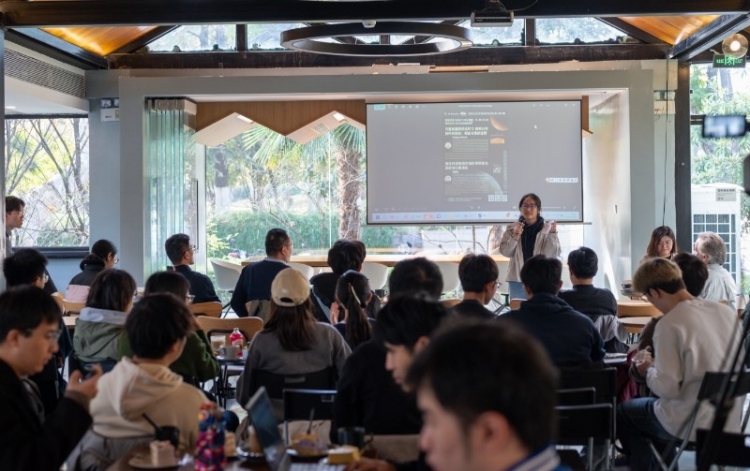
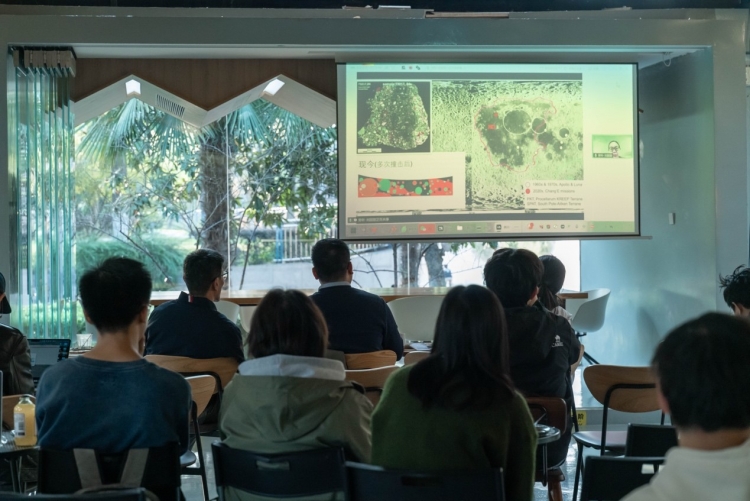
Subsequently, Dr. Liu Tiantian gave an online report titled "Tracing the Early Impact History of the Solar System and Planetary Evolution Through the Moon", systematically presenting the independently developed "3D Spatiotemporal Model of Lunar Crust Structure and Composition Evolution". Based on the impact dynamics of the early lunar formation stage, combined with lunar sample composition data from China's Chang'e Project and the U.S. Apollo Program, as well as high-resolution remote sensing images from lunar orbiters, the model simulates the billion-year-scale impact event sequence and material differentiation process on the lunar surface. Dr. Liu's research reveals that the impact history of the lunar surface may be more consistent with the classic gradual change characteristics, and there is no Late Heavy Bombardment around 3.9 billion years ago. This model can not only restore the formation mechanism of specific craters but also constrain the deep material composition of the Moon, helping to understand how lunar evolution is affected by large impact basins, thereby realizing the inversion of lunar history. Relevant work has provided scientific support for the target site selection of lunar resource exploration missions and the impact risk assessment of the European Space Agency's lunar space station defense project.
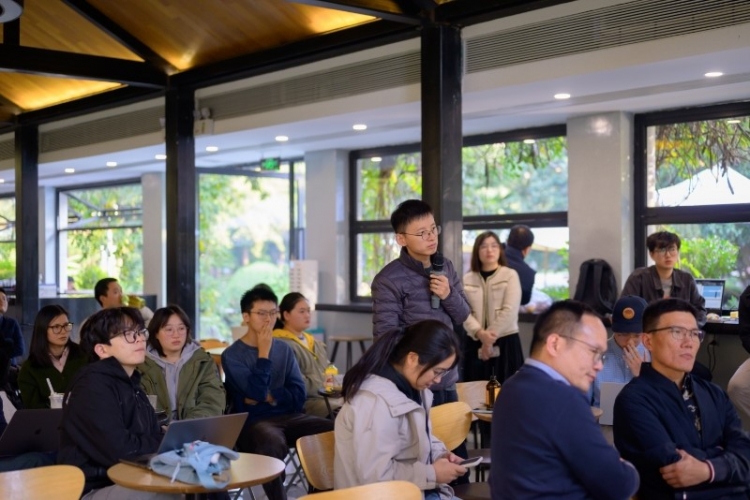
The successful holding of this salon has built a high-level academic exchange bridge for researchers in the fields of planetary science and deep space exploration, promoting in-depth exchanges on cutting-edge directions such as impact processes and solar system evolution. As a key clue to deciphering the history of the solar system, the study of planetary impacts is of great significance for exploring major scientific issues such as planetary formation mechanisms and the environmental conditions for the origin of life.
We look forward to working hand in hand with more academic colleagues and science enthusiasts to make steady accumulations and common progress in subsequent academic explorations, contributing to the sustainable development of China's deep space exploration cause.
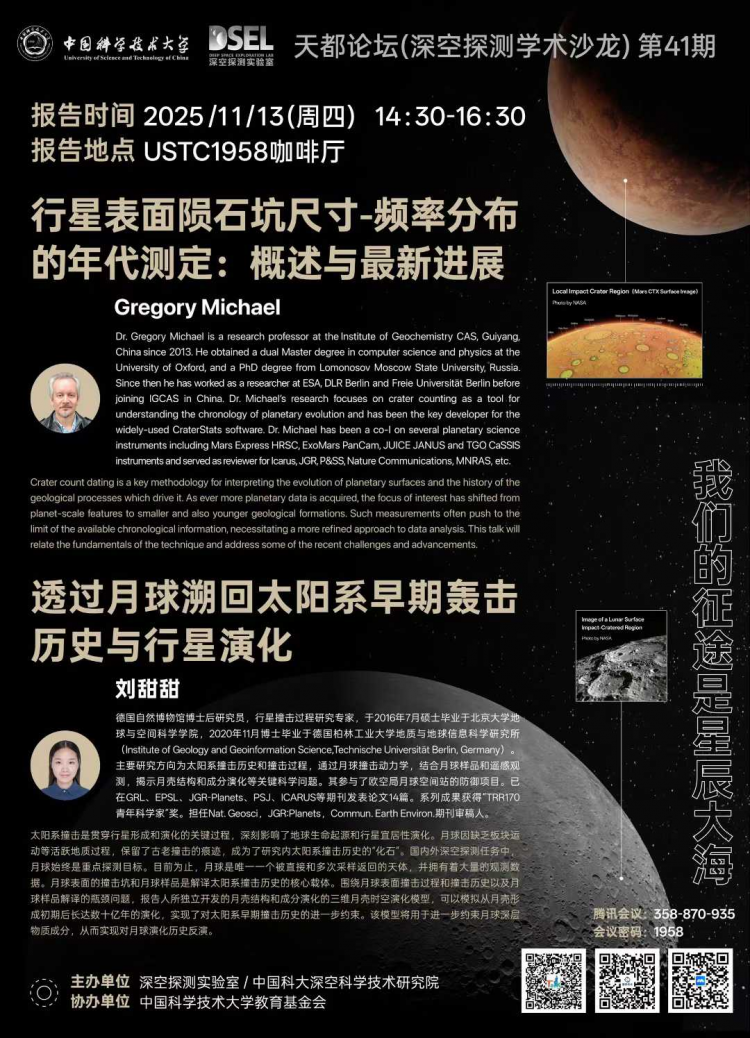
第41期深空探测学术沙龙:聚焦行星撞击,解析太阳系早期演化密码
2025年11月13日下午,第41期深空探测学术沙龙在中国科学技术大学东区1958咖啡厅成功举办。本次沙龙围绕“行星撞击与太阳系演化”核心主题,采用线上+线下双渠道的形式,吸引了众多研究人员、学生参与,现场问答环节科研思路碰撞热烈,学术氛围尤为浓厚。
本次沙龙邀请了中国科学院地球化学研究所研究员Gregory Michael和德国自然博物馆博士后刘甜甜带来两场前沿报告。二者均以 “行星撞击” 为核心研究切入点,围绕解读太阳系早期演化规律这一核心目标展开,并依托深空探测相关数据开展科学分析。
Gregory Michael研究员以“行星表面陨石坑尺寸-频率分布的年代测定:概述与最新进展”为题,系统解析了陨石坑计数法这一解读行星表面演化的关键技术。作为该领域的核心研究者之一,Gregory Michael研究员首先介绍了技术原理:通过统计行星表面不同尺寸陨石坑的数量与分布规律,结合撞击事件的时间概率模型,可反推地貌单元的形成年代。目前Gregory Michael参与开发的CraterStats软件已成为国际行星科学界的常用工具,支撑了多个深空探测项目的年代学分析。
针对当前技术瓶颈,Gregory Michael研究员重点分享了最新进展:随着行星探测数据的爆发式增长,研究焦点正从“行星尺度的古老地貌”转向“更小、更年轻的地质单元”。面对陨石坑年代学的新挑战,Gregory Michael博士在报告中介绍了结合统计学方法合理估计陨石坑定年的结果及其误差,如何评估最小可定年的区域面积和陨石坑数量,以及针对二次坑和地表改造所需进行的空间分布的均一性分析。这些新的技术手段和研究方法有效提升了年轻地貌单元的年代测定精度,并展示了该技术在火星、月球等天体研究中的应用前景。
随后,刘甜甜博士以“透过月球回溯太阳系早期撞击历史与行星演化”为题做了线上报告,系统地介绍了自主开发的“月壳结构与成分演化三维时空模型”。以月球形成初期的撞击动力学为基础,结合嫦娥工程、阿波罗计划的月球样品成分数据,以及绕月探测器的高分辨率遥感影像,模拟了月球表面十亿年尺度的撞击事件序列与物质分异过程。刘博士的工作揭示了月球表面的撞击历史可能更加符合经典的渐变特征,而不存在39亿年左右的晚期重轰击。该模型不仅能还原特定撞击坑的形成机制,还可约束月球深层物质成分,理解月球演化如何受到大型撞击盆地的影响,从而实现对月球历史的反演。相关工作为月球资源探测任务的目标选址及欧空局月球空间站防御项目的撞击风险评估提供了科学支撑。
本次沙龙的成功举办为行星科学与深空探测领域的科研工作者搭建了高水平的学术交流桥梁,促进了撞击过程与太阳系演化等前沿方向的深入交流。行星撞击作为解密太阳系历史的关键线索,其研究对于探索行星形成机制、生命起源环境等重大科学问题意义非凡。
我们期待与更多学界同仁、科研爱好者携手,在后续的学术探索中稳步积累、共同进步,为深空探测事业的持续发展添砖加瓦。

Institute of Deep Space Science and Technology