

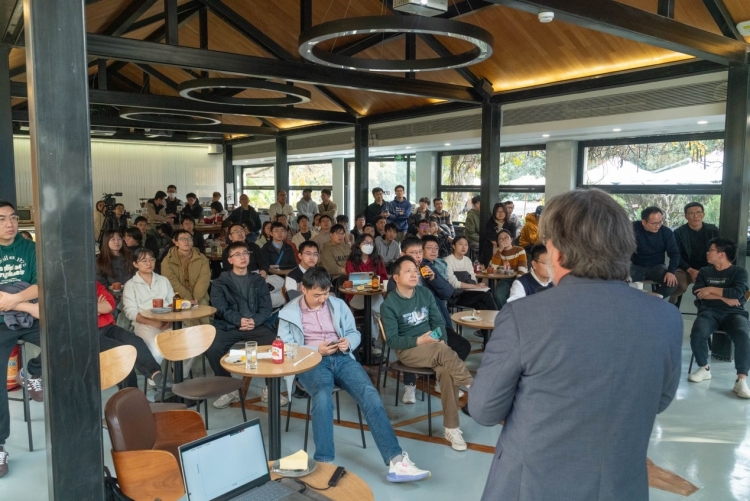
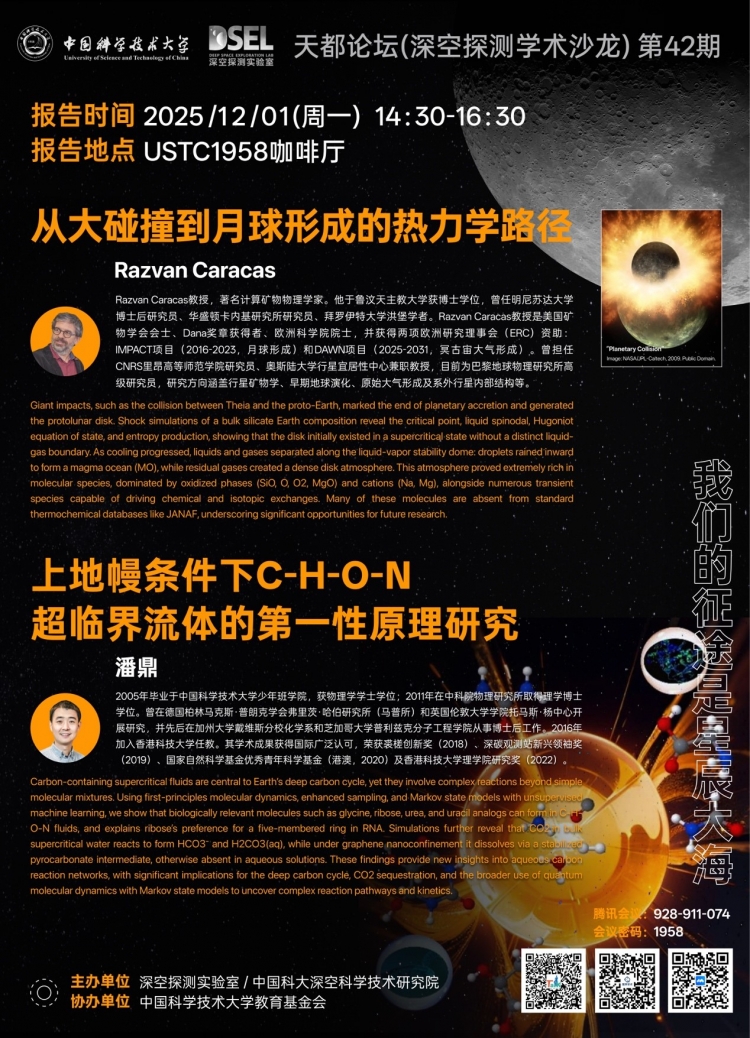
On the afternoon of December 1, 2025, the 42nd Deep Space Exploration Academic Salon was successfully held at the USTC 1958 Café, University of Science and Technology of China (USTC). Centering on the frontier direction of "theoretical calculations of melts and fluids", this session conducted in-depth discussions on key scientific issues such as the Earth-Moon giant impact, material cycle, and origin of life. It attracted numerous teachers, students, and researchers from both on and off campus to participate on-site and garnered extensive online attention. The event specially invited Professor Razvan Caracas, an international computational mineral physicist and Senior Researcher at the Paris Institute of Geophysics, and Professor Pan Ding from the Hong Kong University of Science and Technology to deliver special academic reports.
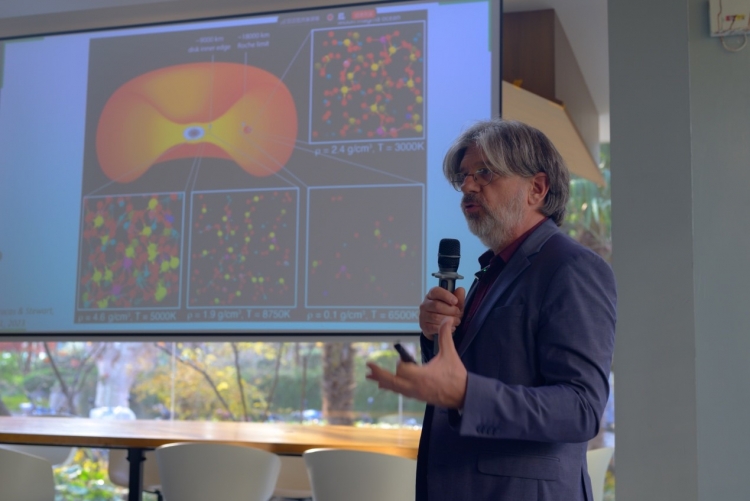
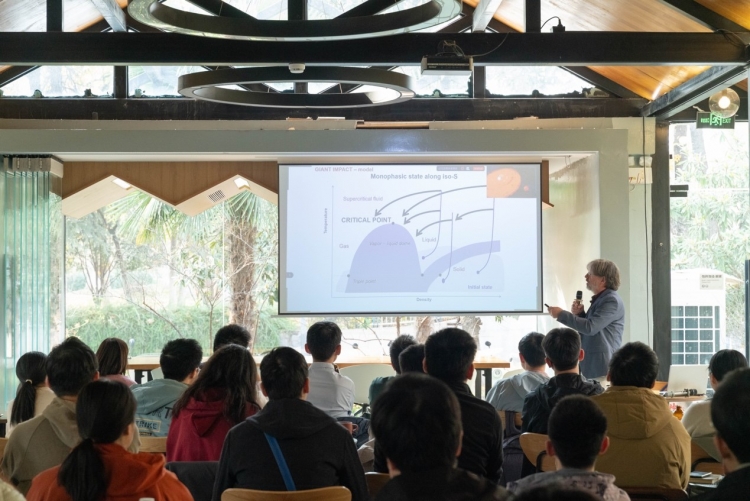
Professor Razvan Caracas has long been engaged in research on planetary mineralogy, early Earth evolution, and the internal structure of exoplanets, and enjoys an outstanding reputation in the field of computational mineral physics. With the title "Thermodynamic Pathways from Giant Impact to Lunar Formation", he systematically elaborated on the thermodynamic evolution process after the giant collision between "Theia" and the primitive Earth. The research points out that this collision not only ended the planetary accretion stage but also directly gave birth to the primitive lunar disk. Through shock simulations on the silicate Earth system, Professor Caracas' team successfully revealed the critical point, phase separation behavior, Hugoniot equation of state, and entropy generation law of the system under extreme conditions, confirming that the primitive lunar disk was in a supercritical state with no obvious gas-liquid boundary in the initial stage. As the system cooled, the fluid gradually separated along the stable region: droplets converged inward to form a magma ocean, while the residual gas constituted a dense disk-shaped atmosphere rich in various molecules and transient active species. Notably, many of these molecules are not included in existing standard thermochemical databases, providing a new breakthrough direction for subsequent related research.
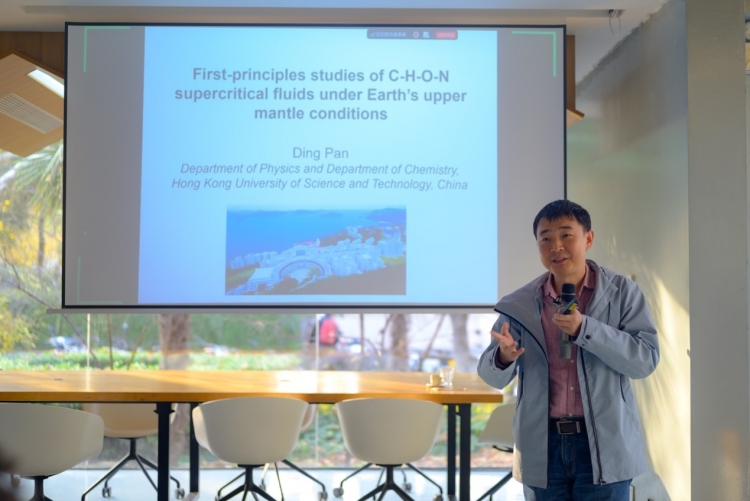
Subsequently, Professor Pan Ding from the Hong Kong University of Science and Technology shared his team's latest achievements with the report titled "First-Principles Studies of C-H-O-N Supercritical Fluids Under Upper Mantle Conditions". Professor Pan Ding pointed out that carbon-bearing supercritical fluids are key carriers of the deep Earth carbon cycle, and their reaction mechanisms are far more complex than simple molecular mixtures. Based on first-principles molecular dynamics, enhanced sampling techniques, and combined with unsupervised machine learning-based Markov state models, the research team for the first time confirmed that life-related molecules such as glycine, ribose, urea, and uracil analogs can spontaneously form in C-H-O-N supercritical fluids, and successfully explained the molecular mechanism why ribose in RNA tends to form a five-membered ring structure. Further simulation studies showed that in bulk supercritical water, CO2 is converted into HCO3- and H2CO3 (aq.); while in the graphene nano-confined environment, CO2 dissolves through a stable pyrocarbonate intermediate that does not exist in conventional aqueous solutions. These findings provide novel insights for understanding the deep carbon cycle, geological sequestration of CO2, and prebiotic chemical processes.
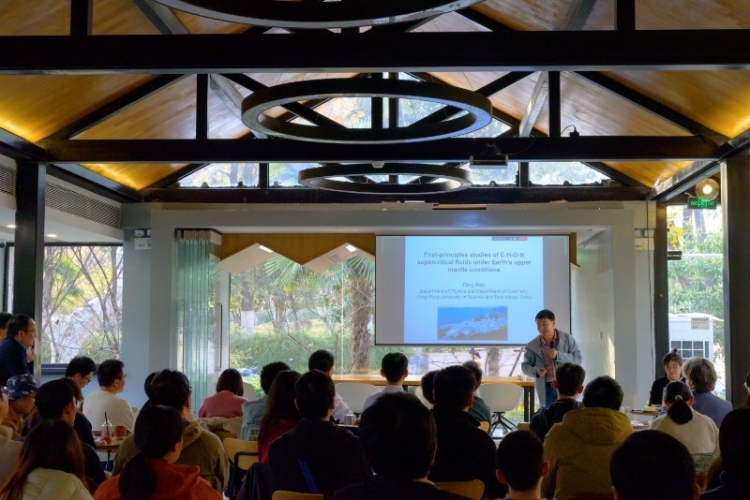
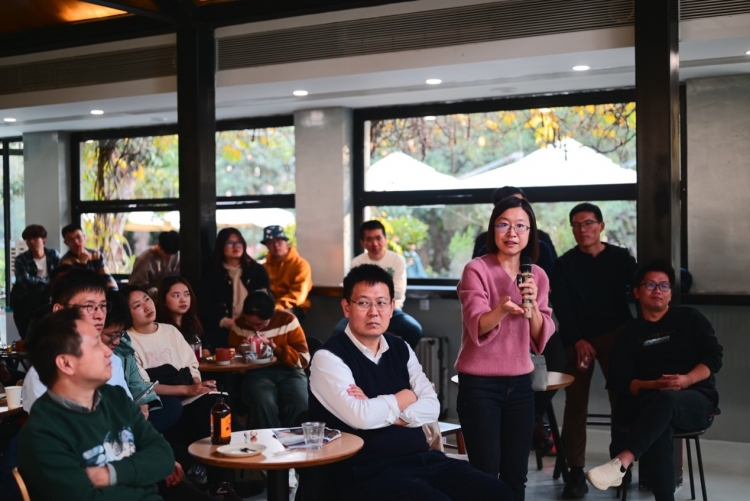
This event was held in an integrated online-offline format with an enthusiastic on-site atmosphere, and was live-streamed simultaneously via Tencent Meeting and the Koushare Academic Platform online. As of press time, the cumulative number of online views has exceeded 5,600. During the Q&A session, the audience actively raised questions regarding simulation methods, data interpretation, and scientific significance. The two speakers gave detailed and in-depth responses, leading to sufficient academic interaction and inspiring multi-angle thinking.
This salon has built a high-level exchange platform for scholars in interdisciplinary fields such as deep space exploration, planetary science, and deep Earth physical chemistry, effectively promoting the discussion and cognitive advancement of major scientific issues such as lunar formation mechanisms and deep Earth material cycles. In the future, the Deep Space Exploration Academic Salon will continue to focus on international frontiers, expand interdisciplinary academic dialogues, and continuously inject momentum into the integrated innovation of China's deep space exploration and Earth science fields.
We look forward to meeting you again on the journey of exploring the mysteries of the universe and the Earth.
第42期深空探测学术沙龙成功举办,聚焦地月形成热力学与地球深部流体化学前沿研究
2025年12月1日下午,第42期深空探测学术沙龙在中国科学技术大学USTC1958咖啡厅成功举行。本期沙龙聚焦“熔流体理论计算”前沿方向,围绕地月大碰撞、物质循环与生命起源等关键科学问题展开深度研讨,吸引了众多校内外师生与科研工作者现场参与,并受到线上广泛关注。活动特邀国际计算矿物物理学家、巴黎地球物理研究所高级研究员Razvan Caracas教授与香港科技大学潘鼎教授作专题学术报告。
Razvan Caracas教授长期从事行星矿物学、早期地球演化及系外行星内部结构研究,在计算矿物物理领域享有盛誉。他以“从大碰撞到月球形成的热力学路径”为题系统阐述了“忒伊亚”(Theia)与原始地球大碰撞后的热力学演化过程。研究指出,这次碰撞不仅终结了行星吸积阶段,也直接催生了原始月球盘。通过对硅酸盐地球体系开展冲击模拟,Caracas教授团队成功揭示了该体系在极端条件下的临界点、相分离行为、Hugoniot状态方程及熵产生规律,证实原始月球盘在初始阶段处于无明显气液分界的超临界态。随着系统冷却,流体沿稳定域逐渐分离:液滴向内汇聚形成岩浆洋,残留气体则构成富含多种分子与瞬态活性物种的致密盘状大气。值得关注的是,其中不少分子未被现有标准热化学数据库收录,这为后续相关研究提供了新的突破方向。
随后,香港科技大学潘鼎教授以“上地幔条件下C-H-O-N超临界流体的第一性原理研究”为题分享了其团队的最新成果。潘鼎教授指出,含碳超临界流体是地球深部碳循环的关键载体,其反应机制远复杂于简单分子混合物。研究团队基于第一性原理分子动力学、增强采样技术,并结合无监督机器学习的马尔可夫状态模型,首次证实C-H-O-N超临界流体中可自发形成甘氨酸、核糖、尿素及尿嘧啶类似物等生命相关分子,并成功阐释了RNA中核糖为何倾向形成五元环结构的分子机理。进一步的模拟研究表明,在体相超临界水中,CO₂会转化为HCO₃⁻与H₂CO₃ (aq);而在石墨烯纳米受限环境中,CO₂则通过一种常规水溶液中不存在的稳定焦碳酸盐中间体实现溶解。这些发现为理解深部碳循环、CO₂地质封存及生命起源前化学过程提供了崭新视角。
本次活动采取线上线下融合形式开展,现场气氛热烈,线上通过腾讯会议与蔻享学术平台同步直播。截至发稿前,线上观看量已突破5600人次。在问答交流环节,听众围绕模拟方法、数据解读与科学意义等问题踊跃提问,两位报告人进行了细致深入的回应,学术互动充分,激发多角度思考。
本期沙龙为深空探测、行星科学及地球深部物理化学等交叉领域学者搭建了高水平的交流平台,有力促进了月球形成机制与地球深部物质循环等重大科学问题的探讨与认知推进。未来,深空探测学术沙龙将继续围绕国际前沿,拓展跨学科学术对话,为我国深空探测与地球科学领域的融合创新持续注入动力。
期待在探索宇宙与地球奥秘的道路上,与您再次相逢。

Institute of Deep Space Science and Technology