

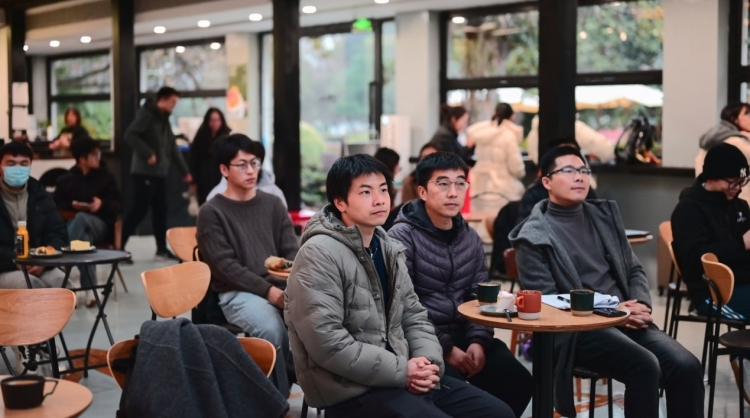
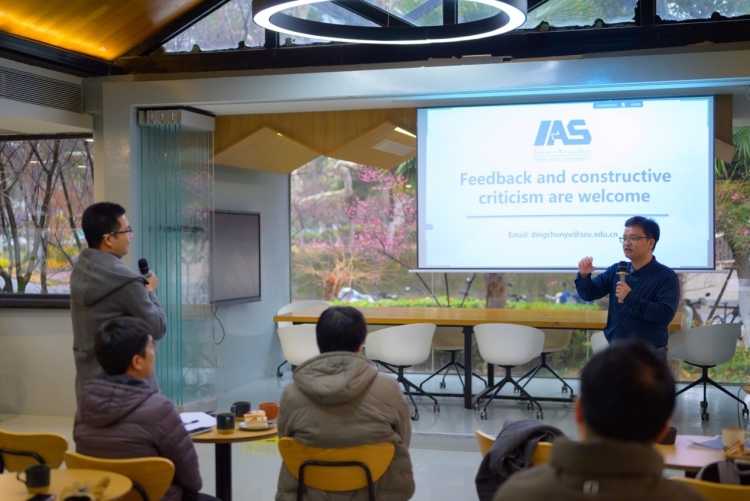
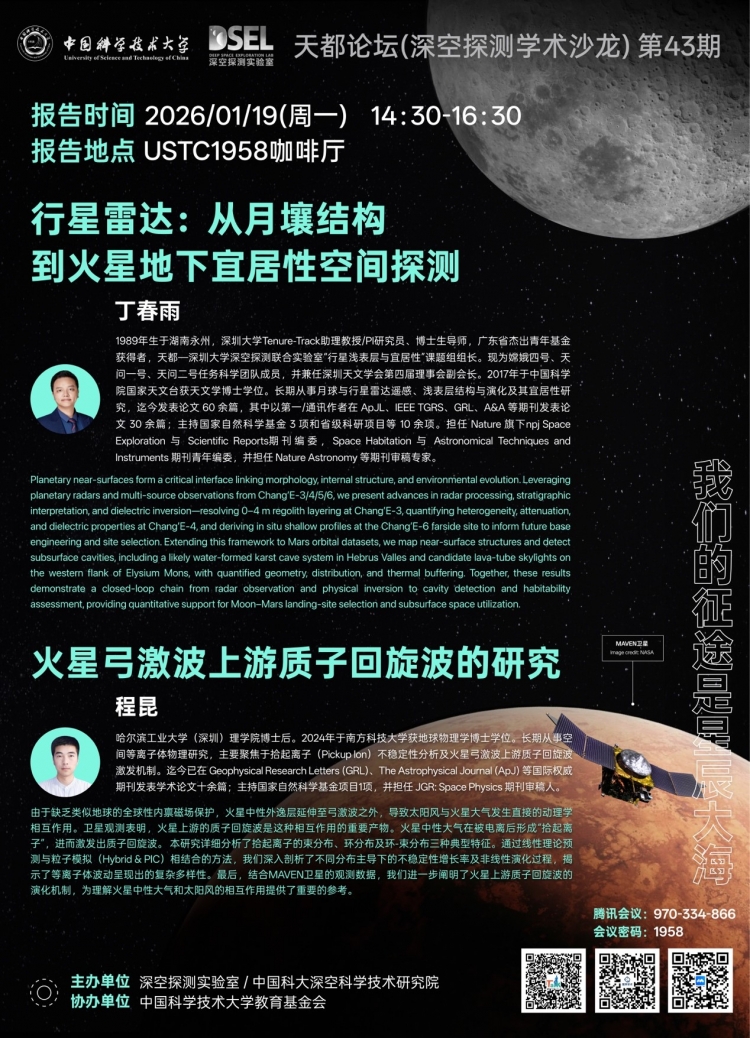
On the afternoon of January 19, 2026, the 43rd Deep Space Exploration Academic Salon was successfully held at 1958 Café in the East Campus of the University of Science and Technology of China (USTC). Focusing on two cutting-edge fields of planetary radar remote sensing and Martian space physics, this salon invited senior scholars to share the latest research results, attracting wide attention from numerous researchers, teachers, students, and deep space exploration enthusiasts, and building a high-quality platform for academic exchange and ideological collision in the field. The two reporters presented cutting-edge research breakthroughs from different dimensions of lunar and Martian exploration respectively.
Reporter Ding Chunyu from Shenzhen University delivered an in-depth analysis of the technical methods and scientific value of planetary near-surface exploration under the title "Planetary Radar: From Lunar Regolith Structure to Habitable Caves on Mars".
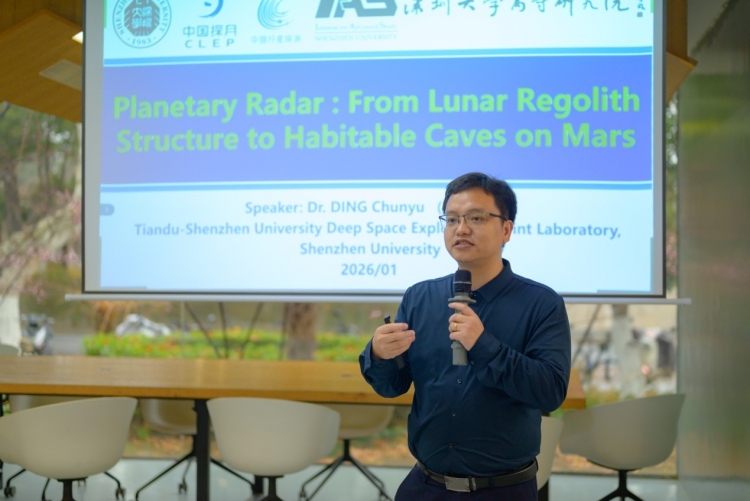
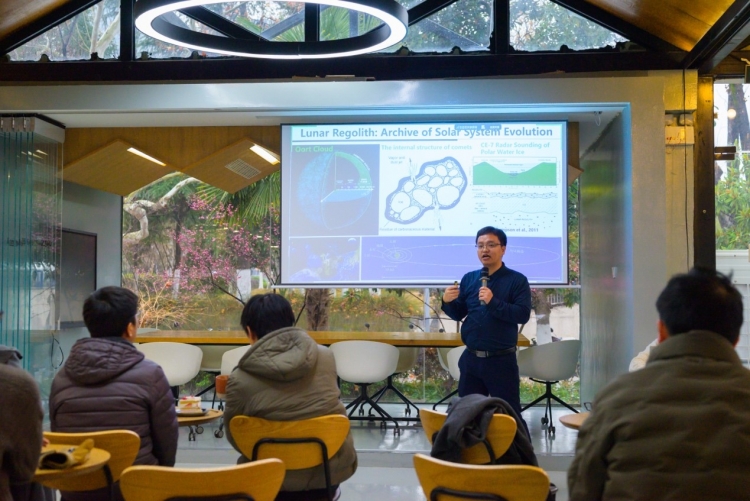
The reporter pointed out that the planetary near-surface is a critical interface connecting planetary morphology, internal structure, and environmental evolution. Relying on planetary radar technology and combining multi-source observation data from Chang'E-3, 4, 5, and 6, the team has achieved significant breakthroughs in radar data processing, stratigraphic interpretation, and dielectric inversion technology: successfully resolving the 0-4m regolith layering structure at the Chang'E-3 landing site, quantifying the heterogeneity, attenuation characteristics, and dielectric parameters of the regolith in the Chang'E-4 area, and obtaining in-situ shallow profile data at the farside site of Chang'E-6, providing core references for the engineering construction and site selection of future lunar bases. On this basis, the team extended the technical framework to the research of Martian orbital data, completed the mapping of Martian near-surface structures and the detection of subsurface cavities, discovered that a likely water-formed karst cave system may exist in Hebrus Valles, as well as suspected lava-tube skylights on the western flank of Elysium Mons, and accurately quantified the geometric shape, distribution characteristics, and thermal buffering capacity of these cavities. Professor Ding Chunyu emphasized that these results have constructed a closed-loop research system of "radar observation - physical inversion - cavity detection - habitability assessment", providing key quantitative support for the selection of lunar and Martian landing sites and the utilization of subsurface space. His report was rich in content and detailed in data, showing the cutting-edge direction of planetary near-surface exploration to the participants.
The second reporter was Cheng Kun, a postdoctoral fellow from the School of Science, Harbin Institute of Technology (Shenzhen). He shared the latest exploration results in the field of Martian space plasma physics under the title "Study on Proton Cyclotron Waves Upstream of the Martian Bow Shock".
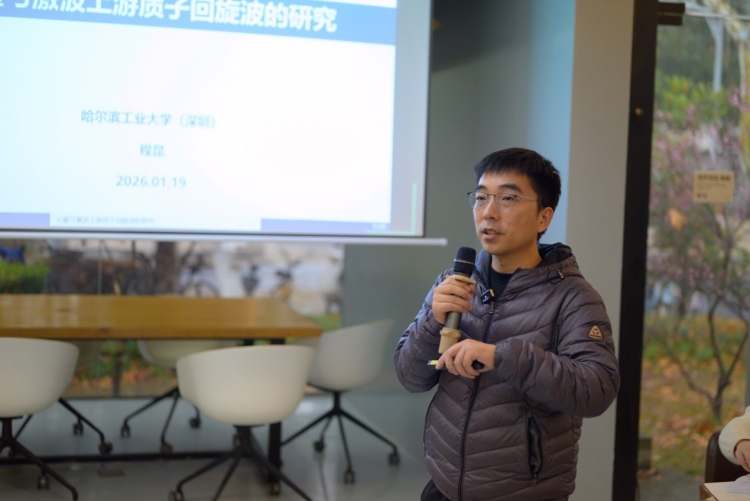
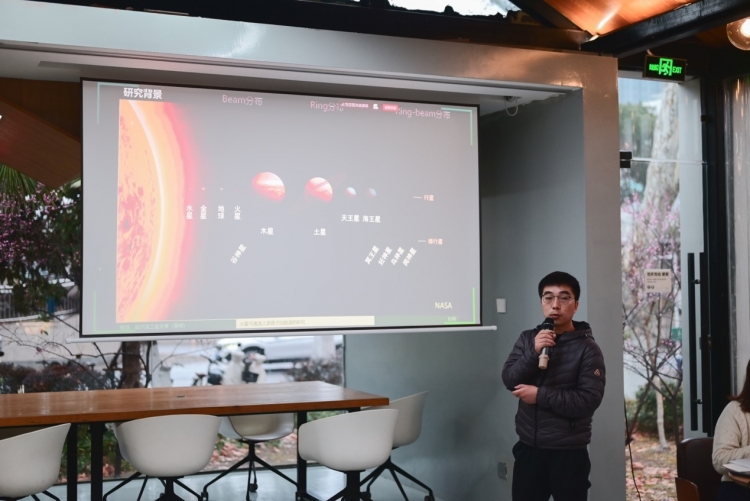
In the report, Dr. Cheng Kun introduced that unlike Earth, Mars lacks the protection of a global intrinsic magnetic field, so its neutral exosphere extends beyond the bow shock, leading to direct kinetic interaction between the solar wind and the Martian atmosphere. The proton cyclotron waves upstream of the Martian bow shock are an important product of this interaction - the "pickup ions" formed after the ionization of the Martian neutral atmosphere further excite the proton cyclotron waves. To deeply explore this process, the team systematically analyzed three typical characteristics of the pickup ion distribution: beam distribution, ring distribution, and ring-beam distribution. By combining linear theory prediction with particle simulation (Hybrid & PIC) methods, the team clearly analyzed the instability growth rate and nonlinear evolution process under the dominance of different distributions, and revealed the complex diversity of plasma waves. Finally, combined with the observation data of the MAVEN satellite, the team further clarified the evolution mechanism of proton cyclotron waves upstream of the Martian bow shock, providing key scientific references for understanding the interaction between the Martian neutral atmosphere and the solar wind. Dr. Cheng Kun's report had a novel perspective and rigorous logic, opening up a new horizon for the participants to understand the characteristics of the Martian space environment.
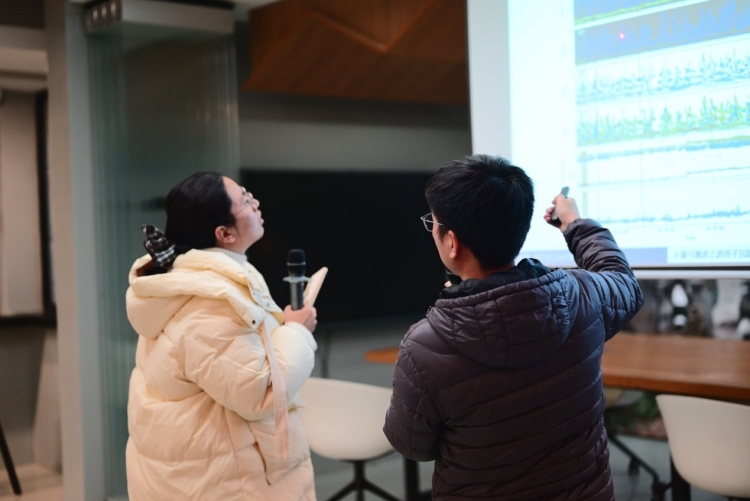
This salon adopted the form of "offline exchange + online live broadcast", open to peers and deep space exploration enthusiasts across the country. As of press time, the online view count has exceeded 6,000 person-times. The interactive question-and-answer session was enthusiastic. The participants actively raised questions about the application of planetary radar technology, the habitability assessment of Martian subsurface cavities, and the observation and verification of proton cyclotron waves. The two reporters carefully answered each question based on their own research experience. The on-site academic exchange atmosphere was strong, and the effect of knowledge sharing was remarkable.
As an important academic exchange platform in the field of deep space exploration, this salon not only demonstrated the cutting-edge achievements in planetary exploration and space physics, but also promoted academic cooperation and ideological integration across units and directions. As core targets of human deep space exploration, the research on the Moon and Mars is of far-reaching significance for revealing the formation and evolution laws of solar system planets and promoting the implementation of future deep space exploration projects. In the future, the Deep Space Exploration Academic Salon will continue to invite more experts and scholars in the field to share the latest research progress, and continuously contribute to promoting the development of China's deep space exploration cause and gathering scientific research and innovation forces.
We look forward to meeting more peers and scientific research enthusiasts in future academic exchanges, jointly exploring the infinite mysteries of the universe, and marching towards the journey of the stars and the sea.
Koushare Live Broadcast Link: https://www.koushare.com/live/details/49642
思想碰撞,共探深空——第43期深空探测学术沙龙在中国科学技术大学成功举办
2026年1月19日下午,第43期深空探测学术沙龙在中国科学技术大学东区1958顺利举办。本次沙龙聚焦行星雷达遥感与火星空间物理两大前沿领域,邀请业内资深学者分享最新研究成果,吸引了众多科研工作者、师生及深空探测爱好者的广泛关注,为领域内学术交流与思想碰撞搭建了优质平台。两位报告人分别从月球与火星探测的不同维度,呈现前沿研究突破。
来自深圳大学的丁春雨研究员,以“行星雷达:从月壤结构到火星地下宜居性空间探测”为题,深入剖析行星浅表层探测的技术方法与科学价值。
报告人指出,行星浅表层是连接行星形态、内部结构与环境演化的关键界面。团队依托行星雷达技术,结合嫦娥三号、四号、五号、六号的多源观测数据,在雷达数据处理、地层解释与介电反演技术上实现重要突破:成功解析嫦娥三号着陆区0-4米月壤分层结构,量化嫦娥四号区域月壤的非均质性、衰减特性与介电参数,同时获取嫦娥六号远月面着陆区原位浅层剖面数据,为未来月球基地工程建设与选址提供核心参考。在此基础上,团队将技术框架拓展至火星轨道数据研究,完成火星浅表层结构测绘与地下空腔探测,发现赫布鲁斯谷可能存在水成喀斯特洞穴系统,以及埃律西昂山西侧坡疑似熔岩管天窗,并精准量化这些空腔的几何形态、分布特征与热缓冲能力。丁春雨研究员强调,这些成果构建起“雷达观测—物理反演—空腔探测—宜居性评估”的闭环研究体系,为月球与火星着陆点选择及地下空间利用提供了关键量化支撑,其报告内容丰富、数据详实,为与会者展现了行星浅表层探测的前沿方向。
第二位报告人是来自哈尔滨工业大学(深圳)理学院博士后程昆,他以“火星弓激波上游质子回旋波的研究”为题,分享火星空间等离子体物理领域的最新探索成果。
报告中,程昆博士介绍,与地球不同,火星缺乏全球性内禀磁场保护,其中性外逸层延伸至弓激波之外,导致太阳风与火星大气直接发生动理学相互作用,而火星弓激波上游的质子回旋波正是这一相互作用的重要产物——火星中性大气被电离后形成“拾起离子”,进而激发质子回旋波。为深入探究这一过程,团队系统分析了拾起离子的束分布、环分布及环-束分布三种典型特征,通过线性理论预测与粒子模拟(Hybrid & PIC)相结合的方法,清晰剖析不同分布主导下的不稳定性增长率及非线性演化过程,揭示出等离子体波动的复杂多样性。最终,团队结合MAVEN卫星观测数据,进一步阐明火星弓激波上游质子回旋波的演化机制,为理解火星中性大气与太阳风的相互作用提供了关键科学参考。程昆博士的报告视角新颖、逻辑严谨,为与会者理解火星空间环境特性打开了新视野。
本次沙龙采用“线下交流+线上直播”的形式,向全国同行及深空探测爱好者开放,截至发稿前,线上浏览量6000余人次。互动问答环节气氛热烈,与会者围绕行星雷达技术应用、火星地下空腔宜居性评估、质子回旋波观测验证等问题积极提问,两位报告人结合自身研究经验逐一细致解答,现场学术交流氛围浓厚,成果共享效果显著。
作为深空探测领域的重要学术交流平台,本次沙龙展示了行星探测与空间物理领域的前沿成果,更促进了跨单位、跨方向的学术合作与思想融合。月球与火星作为人类深空探测的核心目标,相关研究对于揭示太阳系行星形成与演化规律、推动未来深空探测工程落地具有深远意义。未来,深空探测学术沙龙将继续邀请更多领域内专家学者分享最新研究进展,为推动我国深空探测事业发展、汇聚科研创新力量持续贡献力量。
我们期待在未来的学术交流中,与更多同行、科研爱好者相聚,共同探索宇宙的无限奥秘,奔赴星辰大海的征途。

Institute of Deep Space Science and Technology