

Research Overview
Researchers from the University of Science and Technology of China and the National Space Science Center, Chinese Academy of Sciences, have developed MP-DualNet, a dual-branch deep-learning model that automatically determines the position of the magnetopause relative to the imaging field of view (FOV) in soft X-ray images and extracts its two-dimensional projected envelope. On a test set constructed from numerical simulations, MP-DualNet achieved a three-class accuracy of 94.8% and a segmentation intersection over union (IoU) of 97.2%. The model was also examined using a public synthetic image and an independent storm simulation sequence. The study, entitled “MP-DualNet: A Dual-Branch Deep Learning Approach for Magnetopause Boundary Detection Using Simulated SXI Images,” was published in Space Weather.
Research Background
The magnetopause is the key boundary formed by the interaction of the solar wind with Earth's magnetic field. Its position and large-scale morphology vary with solar-wind dynamic pressure and the interplanetary magnetic field. SMILE (Solar wind Magnetosphere Ionosphere Link Explorer) was launched into orbit on 19 May 2026. Its Soft X-ray Imager (SXI) can image the dayside magnetosheath and magnetopause over a wide field of view using soft X-ray emission produced by solar-wind charge exchange. Because the magnetopause does not appear as a sharp contour in these images and may lie partly or entirely outside the field of view, automated analysis must determine both whether the boundary is visible and where it is located in the image.
Method Overview
MP-DualNet combines FOV-state classification with boundary segmentation. The classification branch determines whether the magnetopause lies to the left of, inside, or to the right of the SXI FOV, while the segmentation branch provides the pixel-level location of its two-dimensional projected envelope. The model was trained and evaluated using line-of-sight-integrated soft X-ray intensity maps generated from global hybrid plasma simulations.
Main Results
On the balanced test set of 1,515 images, MP-DualNet achieved a three-class accuracy of 94.8% and a macro-averaged F1 score of 94.7%. The final fused masks reached an F1 score of 98.6% and an intersection over union (IoU) of 97.2%. For samples whose reference magnetopause lay inside the FOV, the predicted and reference boundaries were compared row by row on the native 15×25 SXI angular grid, yielding a mean absolute angular displacement of 0.488°.
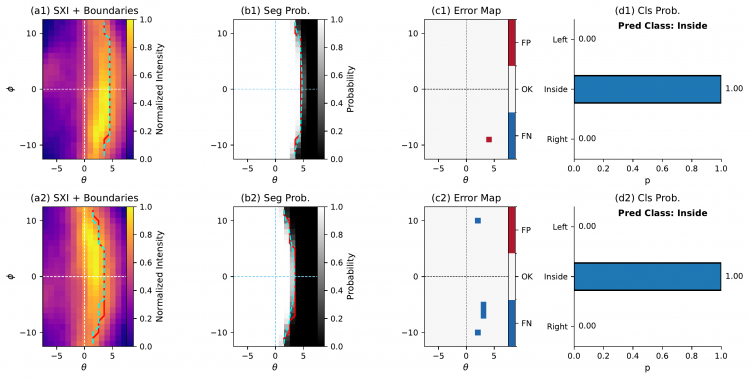
Figure 1. MP-DualNet outputs for two test samples. The model provides both the probabilities of the magnetopause position relative to the FOV and its two-dimensional projected boundary. Comparison between the reference and predicted boundaries illustrates the model's boundary-identification results.
To examine performance beyond the training images, the model was further tested using a public synthetic SXI image from Sun et al. (2020) and a May 2024 storm simulation sequence that was not used to construct the training, validation, or test sets.
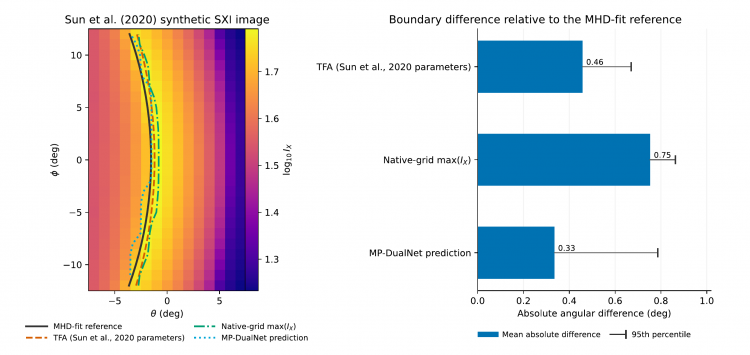
Figure 2. Case comparison using a public synthetic SXI image. The left panel overlays the projected MHD reference boundary, the tangent fitting approach (TFA) boundary reconstructed from the published parameters, the row-wise intensity-maximum locus, and the MP-DualNet prediction. The right panel compares their angular displacements relative to the same reference boundary.
For this public image, the mean absolute angular displacements of the MP-DualNet prediction, the TFA boundary reconstructed from the published parameters, and the row-wise intensity-maximum locus relative to the same projected MHD reference boundary were 0.33°, 0.46°, and 0.75°, respectively. These results show that, in this case, the two-dimensional projected boundary recovered by MP-DualNet is consistent with the reference morphology.
In the storm simulation sequence, the magnetopause entered the image from the right side of the FOV, crossed the FOV, and moved leftward, with the predicted class probabilities changing accordingly. When the boundary was visible, the model prediction followed its dominant position and large-scale morphology. Errors increased when local fine-scale structures became more pronounced, indicating that recovering detailed boundary perturbations remains an area for further improvement.
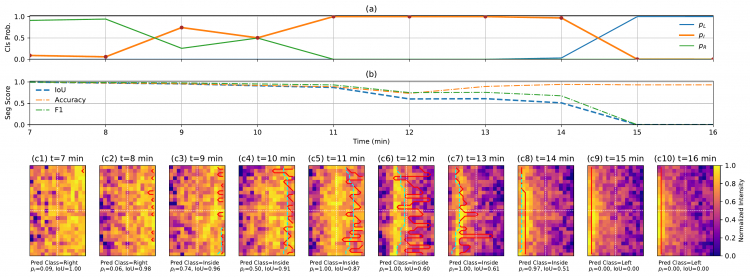
Figure 3. Case test using the May 2024 storm simulation sequence. Panel (a) shows the probabilities of the three FOV states; panel (b) shows IoU, pixel accuracy, and F1; and panels (c1)–(c10) present the SXI images together with the reference and predicted boundaries.
Significance and Scope
MP-DualNet can serve as an automated front end for SXI image analysis by first screening images suitable for magnetopause localization and then providing a two-dimensional projected-boundary constraint for tangent fitting, statistical inversion, or three-dimensional reconstruction. The current results are based on simulated data and a limited number of external cases and do not cover the full range of solar-wind and viewing conditions expected during the SMILE mission. Calibration and validation using real SXI observations remain necessary.
Publication Information
The article, “MP-DualNet: A Dual-Branch Deep Learning Approach for Magnetopause Boundary Detection Using Simulated SXI Images,” was published in Space Weather. Cheng Zhong, a doctoral student at the University of Science and Technology of China, and Zhongwei Yang, a researcher at the National Space Science Center, Chinese Academy of Sciences, contributed equally. Professor Jiajia Liu of the University of Science and Technology of China is the corresponding author. Tianran Sun, Chengyan Huang, Jingnan Guo, Yuming Wang, and Chi Wang are co-authors. Processed synthetic data, pretrained models, and Python code for inference, evaluation, and visualization are archived on Zenodo.
Journal: Space Weather, Volume 24, Issue 10, e2026SW005150
Published online: 13 October 2026
Article: https://doi.org/10.1029/2026SW005150
Data and code: https://doi.org/10.5281/zenodo.22878411
This work was supported by the National Natural Science Foundation of China (42521007, 42188101, 42150105, and 42274210), the National Key R&D Program of China (2025YFF0512102), China's Space Origins Exploration Program, and the Specialized Research Fund for State Key Laboratories of Solar Activity and Space Weather.
USTC Team Develops MP-DualNet, an Automated Magnetopause Detection Framework
成果简介
近日,中国科学技术大学与中国科学院国家空间科学中心合作团队提出双分支深度学习模型MP-DualNet,用于从软X射线图像中自动判断磁层顶相对成像视场(FOV)的位置,并提取其二维投影包络。该模型在由数值模拟构建的测试集上取得94.8%的三分类准确率(Accuracy)和97.2%的分割交并比(IoU),并通过公开合成图像和独立磁暴模拟序列开展了案例检验。相关成果以“MP-DualNet: A Dual-Branch Deep Learning Approach for Magnetopause Boundary Detection Using Simulated SXI Images”为题,发表在Space Weather。
研究背景
磁层顶是太阳风与地球磁场相互作用形成的关键边界,其位置和大尺度形态会随太阳风动压及行星际磁场变化。SMILE卫星(Solar wind Magnetosphere Ionosphere Link Explorer)已于2026年5月19日发射入轨。该卫星搭载的软X射线成像仪(SXI)可通过太阳风电荷交换产生的软X射线辐射,对日侧磁鞘和磁层顶开展大视场成像。由于磁层顶在图像中并非清晰锐利的轮廓,且可能部分或完全位于视场之外,自动分析既要判断边界是否可见,也要确定其在图像中的位置。
方法概述
MP-DualNet将视场状态分类与边界分割结合起来:分类分支判断磁层顶位于SXI视场左侧、视场内或视场右侧;分割分支给出二维投影包络的像素级位置。模型使用全球混合等离子体模拟生成的视向积分软X射线强度图进行训练和评估。
主要结果
在包含1,515幅图像的测试集上,MP-DualNet的三分类准确率为94.8%,宏平均F1为94.7%;最终融合掩膜的F1为98.6%,交并比(IoU)为97.2%。对于参考磁层顶位于视场内的样本,在SXI原始15×25角度网格上逐行比较预测边界与参考边界,平均绝对角位移为0.488°。
图1 MP-DualNet在两个测试样本上的输出。模型同时给出磁层顶相对视场的位置概率和二维投影边界;参考边界与预测边界的对照展示了模型的边界识别结果。
为检验模型在训练图像之外的表现,研究进一步采用Sun等(2020)公开的合成SXI图像,以及未参与训练、验证和测试集构建的2024年5月磁暴模拟序列开展案例检验。
图2 公开合成SXI图像上的案例比较。左图叠加投影MHD参考边界、传统切线拟合法(TFA)重建边界、逐行强度极大值轨迹和MP-DualNet预测边界;右图比较它们相对同一参考边界的角度差异。
在该公开图像上,MP-DualNet预测边界、根据文献参数重建的TFA边界和逐行强度极大值相对同一投影MHD参考边界的平均绝对角位移分别为0.33°、0.46°和0.75°。这一结果表明MP-DualNet在该案例中恢复的二维投影边界与参考形态较为一致。
在磁暴模拟序列中,磁层顶由视场右侧进入图像、穿过视场并向左移动,模型给出的类别概率随之转换;当边界可见时,模型预测能够跟随其主要位置和大尺度形态变化。局部细尺度结构增强时误差有所增加,说明恢复精细边界扰动仍是后续需要改进的方向。
图3 2024年5月磁暴模拟序列的案例检验。图a为三类视场状态概率,图b为IoU、像素准确率和F1,图c1-c10展示SXI图像以及参考边界和预测边界。
研究意义
MP-DualNet可作为SXI图像分析的自动化前端,先筛选适合开展磁层顶定位的图像,再为切线拟合、统计反演或三维重构提供二维投影边界约束。现有结果基于模拟数据和有限的外部案例,尚不能覆盖SMILE任务期间全部太阳风和观测条件;后续仍需利用真实SXI观测开展标定与验证。
论文信息
中国科学技术大学博士研究生钟程与中国科学院国家空间科学中心研究员杨忠炜为论文共同第一作者,中国科学技术大学刘佳佳教授为通讯作者;孙天然、黄承彦、郭静楠、汪毓明和王赤为共同作者。处理后的合成数据、预训练模型,以及用于推理、评估和可视化的Python代码已公开存档于Zenodo。
论文题目:MP-DualNet: A Dual-Branch Deep Learning Approach for Magnetopause Boundary Detection Using Simulated SXI Images
期刊:Space Weather, Volume 24, Issue 10, e2026SW005150
在线发表:2026年10月13日
论文链接:https://doi.org/10.1029/2026SW005150
数据与代码:https://doi.org/10.5281/zenodo.22878411
研究得到国家自然科学基金(42521007、42188101、42150105、42274210)、国家重点研发计划(2025YFF0512102)、中国空间起源探索计划以及太阳活动与空间天气全国重点实验室专项研究基金的支持。

Institute of Deep Space Science and Technology