

The bow shock is the first interface where celestial bodies interact with the interplanetary solar wind. Its dynamic behavior not only reflects the disturbance effect of the solar wind on celestial bodies but also the magnetic field and plasma characteristics of the celestial bodies themselves, serving as a crucial interface for understanding the state and variation mechanisms of the celestial space environment. Recently, an international research team led by Professor Wang Yuming from the University of Science and Technology of China (USTC) has achieved significant progress in understanding how Mars' bow shock responds to the solar wind. The team analyzed magnetic field and plasma observation data from China's first Mars exploration mission, the Tianwen-1 orbiter, combined with data from NASA's MAVEN spacecraft. The research results, titled "Bow Shock Oscillations of Mars Under Weakly Disturbed Solar Wind Conditions," were published in Nature Communications as a Featured Article of the issue.
Mars' bow shock is a region where the supersonic solar wind decelerates to subsonic speeds and deflects near Mars. Its position reflects the magnitude of the interaction between the solar wind and Mars' space environment. The location of Mars' bow shock is influenced by multiple parameters, including solar extreme ultraviolet irradiance, solar wind dynamic pressure, and the strength and direction of the interplanetary magnetic field. Previously, the research team used magnetometer data from Tianwen-1 and the advantage of simultaneous observations with MAVEN to demonstrate, for the first time, the minute-scale and hundred-kilometer-scale global oscillatory behavior of Mars' bow shock caused by significant solar wind disturbances, which was published in Geophysical Research Letters. However, the team observed that under weak solar wind disturbances, Mars' bow shock is mostly stable but occasionally exhibits minute-scale and hundred-kilometer-scale global oscillations (as shown in the figure below).
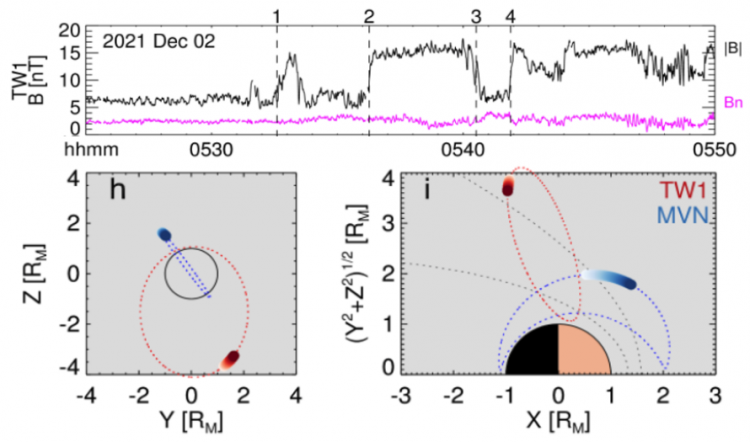
Fig 1. Mars' bow shock oscillation event observed by the Tianwen-1 orbiter on December 2, 2021.
The physical process behind this special phenomenon remains unclear: is it caused by the rotation of Mars carrying crustal remanent magnetism, or driven by special solar wind conditions? Building on previous work, the research team analyzed the distribution characteristics of Mars' crustal magnetic field and multiple solar wind parameters using joint observation data from the Tianwen-1 orbiter and NASA's Mars Atmosphere and Volatile EvolutioN (MAVEN) spacecraft. They found that when the solar wind Mach number is low, Mars' bow shock is weak and prone to oscillations even under slight disturbances; when the Mach number is high, the bow shock may remain relatively stable despite stronger disturbances. This phenomenon was further verified through global three-dimensional magnetohydrodynamic numerical simulations of Mars (Figure 2).
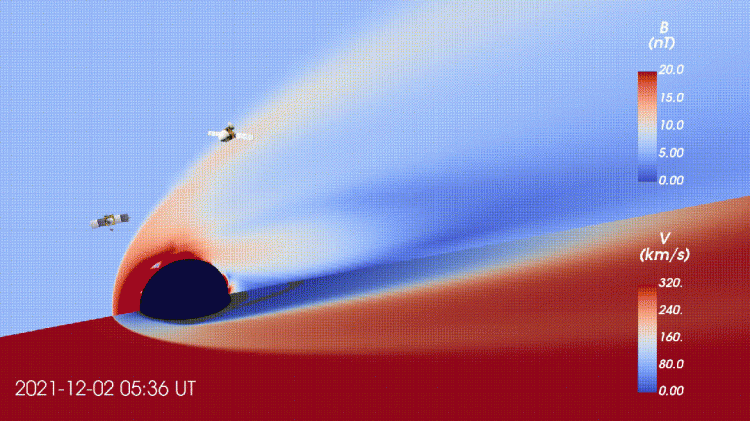
Fig 2. Numerical simulation results of the bow shock oscillation event, showing large-scale global oscillations induced by weak solar wind disturbances under low Mach numbers.
Based on independent exploration data from China's Tianwen-1 mission, particularly high-precision spatial magnetic field measurement data provided by the Mars Orbiter Magnetometer (MOMAG) developed by USTC, this study reveals the response mechanism of Mars' space environment to weak solar wind disturbances. The achievement improves the understanding of the interaction mechanism between the solar wind and Mars' space environment, and deepens the comprehension of the interaction process between the solar wind and unmagnetized planets. The Tianwen-1’s MOMAG was developed by the space payload team of USTC led by Professor Wang Yuming. It was officially put into long-term operation in Martian orbit in November 2021 and has been continuously working ever since, supporting the research of multiple domestic and foreign teams. To date, nearly 30 original achievements have been produced or are in press (https://space.ustc.edu.cn/dreams/tw1_momag/), marking China's first realization of high-precision measurement of Mars' spatial magnetic field.
Professor Wang Yuming from USTC is the corresponding author of the paper, and Dr. Cheng Long is the first author. This research work was supported by the Key Program and Basic Science Center Program of the National Natural Science Foundation of China, as well as CAS Strategic Priority Research Program (Category B) titled "Formation, Evolution and Habitability of Terrestrial Planets."
Paper link: https://www.nature.com/articles/s41467-025-65011-8
Reproduced from: Planetary Science
天问一号环绕器取得最新进展,揭示了火星弓激波整体大幅振荡的原因
弓激波是天体与行星际太阳风相互作用的第一道界面,其动态变化的行为不仅反映了太阳风对天体的扰动影响,还反映了天体本身的磁场和等离子体特性,是理解天体空间环境状态和变化规律的重要交界面。近日,中国科学技术大学汪毓明教授领衔的国际研究团队,利用我国首次火星探测任务“天问一号”环绕器的磁场和等离子体观测数据,结合美国MAVEN探测器的观测数据,在火星弓激波对太阳风响应方面取得重要进展。研究成果以“Bow Shock Oscillations of Mars Under Weakly Disturbed Solar Wind Conditions”为题,发表在《自然·通讯》(Nature Communications)上,并为当期Featured Article。
火星弓激波是超声速太阳风在火星附近减速为亚声速并发生偏转的区域,其位置反映了太阳风与火星空间环境相互作用的强度。火星弓激波位置受太阳极紫外辐射、太阳风动压、行星际磁场强度和方向等多种参数影响。研究团队曾利用天问一号的磁强计数据,及其与MAVEN号的同时观测的优势,首次展示了太阳风显著扰动引起的火星弓激波分钟尺度、百公里量级的整体振荡行为,发表在《Geophysical Research Letters》上。然而,研究中团队发现,在微弱的太阳风扰动下,火星弓激波大多比较平稳,但有时也会发生分钟尺度、百公里量级的整体振荡(下图所示)。
而这一特殊现象,是由于携带岩石剩磁的火星自转引起的,还是太阳风特殊条件驱动的?其物理过程并不清楚。在前期工作基础上,研究团队利用天问一号环绕器与“火星大气与挥发物演化”(MAVEN)探测器的联合观测数据,通过对火星岩壳磁场分布特征和太阳风多个参数的分析发现,当太阳风马赫数较低时,火星弓激波强度较弱,即使受到轻微扰动也容易引发振荡;而在马赫数较高时,即便扰动更强,弓激波仍可能保持相对稳定。这一现象通过火星全球三维磁流体力学数值模拟得到了进一步验证(图2)。
该研究基于我国天问一号的自主探测数据,特别是中国科学技术大学负责研制的火星磁强计所提供的高精度空间磁场测量数据,揭示了火星空间环境对弱太阳风扰动的响应机制。该成果完善了对太阳风与火星空间环境相互作用机制的认识,深化了太阳风与非磁化行星相互作用过程的理解。天问一号火星磁强计由汪毓明教授领衔的中国科大空间载荷团队研制,2021年11月在环火轨道正式长期开机并持续工作至今,支撑了国内外多个研究团队的相关工作,至今已产出和待产出近30项原创性成果(https://space.ustc.edu.cn/dreams/tw1_momag/),标志着我国首次实现了火星空间磁场的高精度测量。
中国科学技术大学汪毓明教授为论文通讯作者,程龙博士为第一作者。该研究工作得到了国家自然科学基金重点项目、基础科学中心项目、以及中国科学院战略性先导科技专项(B类)“类地行星的形成演化及其宜居性”等的支持。
论文链接:https://www.nature.com/articles/s41467-025-65011-8
文章转载自:行星科学

Institute of Deep Space Science and Technology